 +
+

Why Do Torsion Bar End Designs Largely Look Similar?
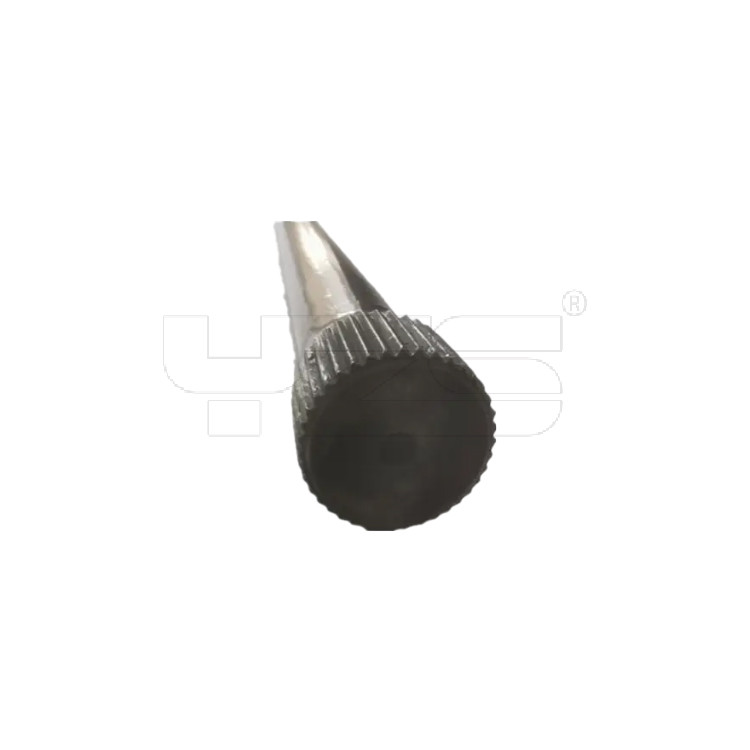
The fundamental reason torsion bar ends share common design features is that they must solve the same set of engineering challenges efficiently and reliably. While variations exist for specific applications, the core design philosophy remains consistent.
1. The Primary Challenge: Transferring Torque
A torsion bar’s job is to twist along its length. The ends must efficiently transfer high torsional loads from the connected parts (suspension arm, chassis anchor) into the bar itself, without slipping or failing.
Common End Solutions:
Splined Ends (Most Common): A series of ridges (splines) machined around the circumference.
Why it's universal: It provides the largest surface area for torque transfer, distributes stress evenly, and allows for fine adjustment (the bar can be rotated a few splines to pre-tension it and adjust ride height). The mating part has matching internal splines.
Hexagonal or Square Ends: A simpler, multi-flat design.
Why used: Easier and cheaper to machine for lower-stress applications. Provides positive engagement but with less adjustability and slightly higher stress concentration at the corners than splines.
Keyed Ends: A single slot (keyway) for a square key.
Why less common for main springs: Less robust for bi-directional, high-cycle fatigue loads compared to splines. May be seen in stabilizer bars or secondary applications.
Conclusion on Shape: Splines are the near-universal choice for automotive suspension torsion bars because they optimally balance strength, durability, and functionality.
2. The Critical Need: Managing Stress Concentration
The point where the smooth, torsional body of the bar meets the end fitting is a major stress concentrator. Sudden changes in shape can lead to crack initiation and fatigue failure.
Universal Design Response:
Generous Fillet Radii: All well-designed torsion bar ends feature a large, smooth, curved transition (fillet radius) between the shank and the splined/hex section. This gradual change in cross-section distributes stress smoothly, dramatically improving fatigue life.
Avoiding Sharp Corners: This is a non-negotiable rule in torsion bar design.
3. The Requirement for Adjustment & Assembly
Torsion bar suspensions often require pre-setting during installation to achieve the correct ride height and spring rate.
Universal Design Feature:
Adjustment Mechanism: The splined design inherently allows for this. One end is fixed to the chassis with splines, and the other end (connected to the suspension arm) can be indexed by one or more spline teeth during installation to apply the precise amount of pre-load torsion.
4. Standardization and Manufacturing
Cost-Effective Machining: Spline rolling or machining is a highly standardized, efficient process for high-volume production.
Tooling and Compatibility: Using common designs reduces tooling costs and ensures compatibility with suspension arms and anchor brackets across different vehicle models or platforms.
Contact Person
- Full Name:
- Jessica
- Tel:
+86 576-87221128
+86 13736677602
- WhatsApp:
- 8613736677602
- Address:
- Building 62, Chuangrong Industrial Zone, Yucheng Street, Yuhuan, Zhejiang 317600
subscription
Signup for our newsletter to stay up-to-date on our promotions, discounts, sales, special offers and more