 +
+

Why Do Control Arms Come in Pairs?
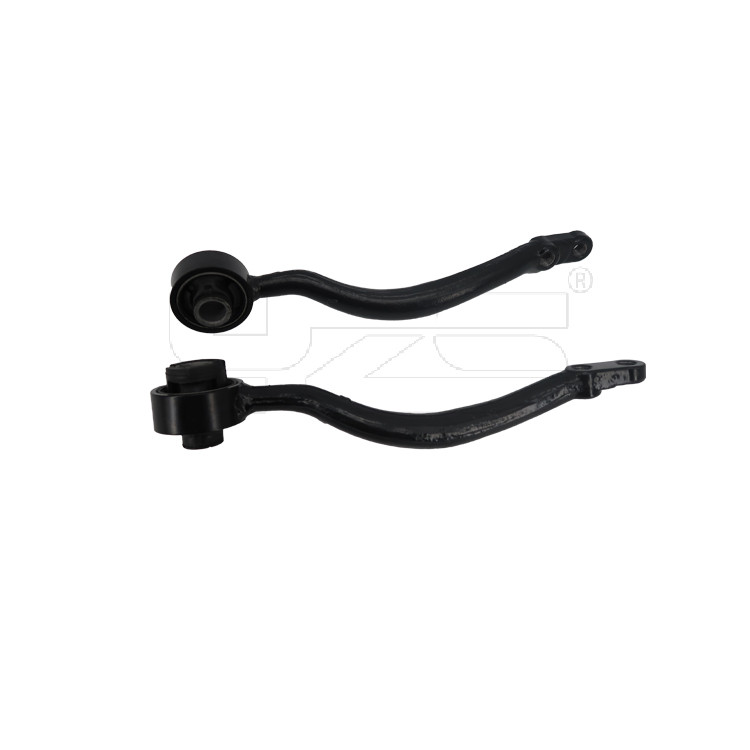
Why Do Control Arms Come in Pairs?
Core Answer: To achieve precise kinematic constraint and control the tire's contact geometry with the road, which is crucial for steering, handling, and stability.
Think of it like a human arm: a single ball-and-socket joint (like the shoulder) allows the arm to swing freely in many directions. To precisely guide the arm's motion (like for a hammering or pushing/pulling action), you need a second fixed point (like the elbow or hand). The pair of control arms in a car's suspension serves exactly this role of "guiding and constraining."
A detailed breakdown of the specific reasons and functions follows:
1. Kinematic Constraint
A wheel has six potential degrees of freedom relative to the vehicle's body: up/down, left/right, fore/aft movement, and rotation around these three axes. A core task of the suspension system is to constrain these unwanted movements, permitting only vertical motion and the necessary steering rotation.
The Single Control Arm Problem: A single arm (e.g., a simple trailing arm) can only effectively constrain movement in one primary direction (usually fore/aft). The wheel would have excessive freedom to swing sideways like a pendulum, leading to extremely unstable vehicle behavior.
The Dual Control Arm Solution (Double Wishbone Suspension): By using a pair of transverse arms (upper and lower control arms), which may be parallel or non-parallel, you create a four-bar linkage. This perfectly constrains the wheel, allowing only pure vertical motion (along with the designed rotation for steering). This is the classic design for precise kinematics.
2. Controlling Camber Change
The ideal wheel attitude is to remain as perpendicular to the road surface as possible under all conditions to maximize the tire contact patch. Paired control arms, through careful design of their lengths and mounting points, can actively manage the change in the wheel's camber angle as it moves up and down (jounces and rebounds).
Engineers can adjust the length ratio between the upper and lower arms (known as the "motion ratio") to induce a slight negative camber as the wheel compresses. This provides greater grip from the outer tire during cornering. This is difficult to achieve with a single-arm suspension like the MacPherson strut, which uses one arm and a shock absorber/strut assembly as the upper pivot.
3. Resistance to Torque and Force Management
Control arms must withstand immense multi-directional forces during driving: torque forces during braking, lateral forces during steering, and vertical impacts from road irregularities.
Load Distribution: Two control arms (often one shorter, one longer) distribute these forces more effectively across two different anchor points on the subframe or vehicle body, enhancing stiffness and durability.
Forming a Stable Triangle: In a top view, the two arms and the steering knuckle (wheel hub carrier) form a rigid triangle. This structure is crucial for resisting torque generated during steering and braking, preventing distortion of the wheel geometry and ensuring precise steering and stable braking.
Contact Person
- Full Name:
- Jessica
- Tel:
+86 576-87221128
+86 13736677602
- WhatsApp:
- 8613736677602
- Address:
- Building 62, Chuangrong Industrial Zone, Yucheng Street, Yuhuan, Zhejiang 317600
subscription
Signup for our newsletter to stay up-to-date on our promotions, discounts, sales, special offers and more